The problem it solves
Code review was designed for humans reviewing human-written code. When AI writes the code, several things break at once:- Developers approve PRs they can’t fully explain
- Bugs and security issues slip through because nobody has time to read every AI-generated line
- Nobody knows the blast radius — how much of the codebase this change touches, or what it breaks
- There’s no record of what was reviewed, what policies ran, or whether approval gates were respected
- The gap between “merged” and “in production” is opaque — artifacts, deployments, and incidents aren’t connected to the code that caused them
What Review agents do
Local code review
Before you push code changes to git, the Review agent analyzes your local changes and surfaces issues — security vulnerabilities, performance problems, maintainability concerns, and more — before they ever enter the pipeline. This means your commits arrive at PR with a higher baseline quality. Fewer rounds of review. Faster merge. Less risk of reaching production.PR review
Once a PR is opened, the Review agent activates and performs a full analysis based on the review types you’ve configured. Findings are posted directly to the PR and appear in full detail on the SenseLab dashboard. You choose what your agent reviews:Code Security
Identifies vulnerabilities, insecure patterns, and risky dependencies introduced by AI-generated code — flagged before they merge.
Code Performance
Surfaces inefficiencies, unnecessary complexity, and patterns likely to cause latency or resource issues in production.
Code Maintainability
Flags code that will be hard to understand, test, or modify — helping teams keep AI-generated code as manageable as human-written code.
Custom review types
Configure your agent to focus on what matters most to your team — from naming conventions to architectural patterns to compliance-specific checks.
Review visibility
PR review findings
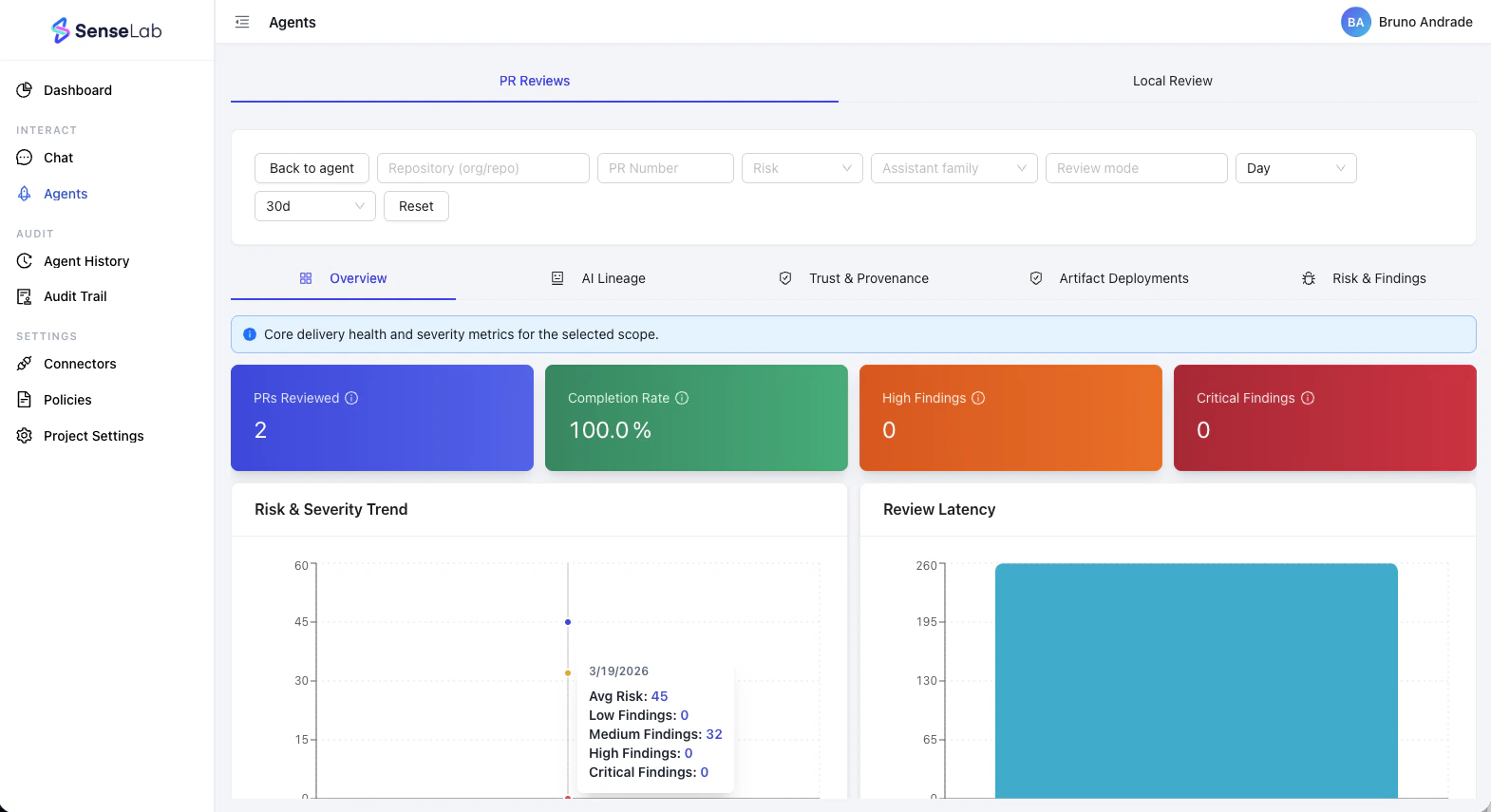
Every finding is logged in full detail: the affected file and line, the issue type, the severity, and the agent’s reasoning. Findings are grouped by category and linked directly to the PR.PR timeline
The dashboard shows a complete timeline of each PR: when it was opened, when each review check ran, who approved it, when it was merged, and what happened to it after merge. Nothing is lost.AI lineage
For every PR, the agent estimates how much of the code was written by AI vs. the developer. This gives teams visibility into AI contribution rate — relevant for IP exposure, risk assessment, and understanding where AI is driving output.Artifact lineage
The Review agent tracks the full journey from code to running service:- PR opened and commits made
- Build artifacts created (container images, binaries, packages) and where they were stored
- Deployment correlated to the artifact
- How the artifact reached the target service after deployment
Trust, provenance, and evidence pack
This is the foundation of SenseLab’s compliance story. As the Review agent performs its analysis, it assembles a trust and provenance bundle for every PR — a structured evidence package that records:- Attestations for each review check performed
- Which policies were executed, and whether they passed or failed
- Whether the PR was gated on approval before merging
- The agent’s identity and the timestamps of every action
The trust and provenance bundle created at review time becomes the evidence foundation for your Release agent’s compliance exports. Every sprint without a Review agent is a sprint with no evidence record.
Multiple agents, multiple repos
Interact with your Review agents
Review agents aren’t just automated pipelines — they’re agents you can talk to and connect to your existing tools.Slack
Talk to your Review agent directly in Slack — ask about past findings, get its opinion on a PR, or query its activity history. It responds in context, scoped to its assigned repositories and review history.
Dashboard Chat
The same conversation interface is available on the SenseLab dashboard. Ask questions, dig into findings, and get answers without leaving your workflow.
MCP Server
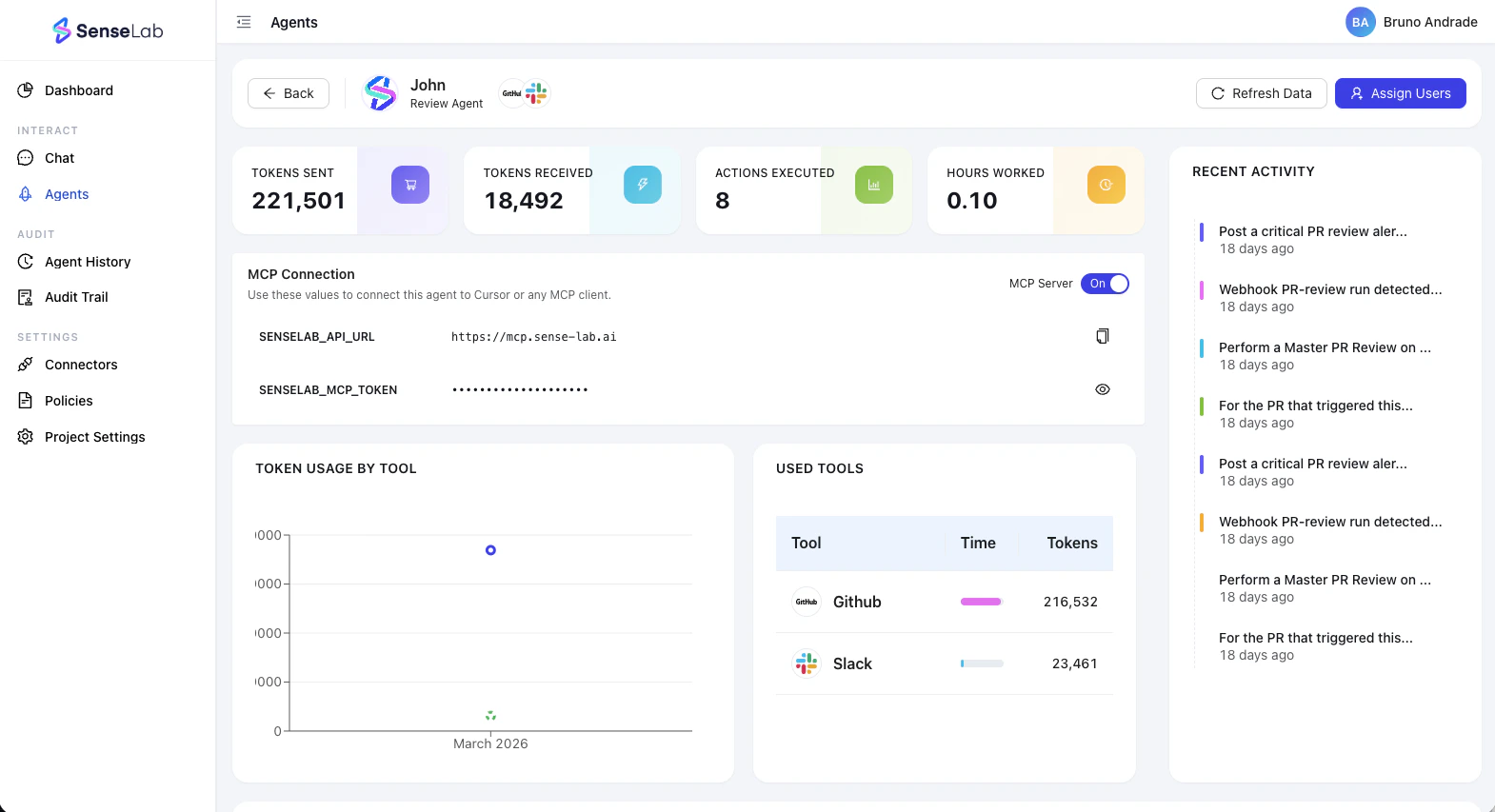
Every Review agent gets its own MCP server that can be enabled or disabled. Connect it to Claude, Cursor, or any MCP-compatible tool to automate code development, testing, and shipping — with your Review agent as a live collaborator.
Agent Management
A dedicated interface for each agent showing every action it has taken, how long it has been active, and controls to extend or modify its assigned functions — add review types, change scope, update policies.
Why it matters
For engineering teams
Stop spending cycles on code review that could be automated. Let the agent catch the obvious issues so reviewers can focus on architecture, product logic, and the things that actually require human judgment.
For security teams
Every PR reviewed, every finding logged, every dependency surfaced — before it merges. No more discovering what the AI quietly added three sprints later.
For compliance and legal
A machine-readable trust and provenance bundle exists for every PR that went through a Review agent. When an auditor asks what was reviewed, what policies ran, and who approved — you have a complete, structured answer.
What’s next
Onboarding
Set up connectors and create your first Review agent.
Release
See how Review agent evidence feeds into Release SBOM and AIBOM generation.