
The loop
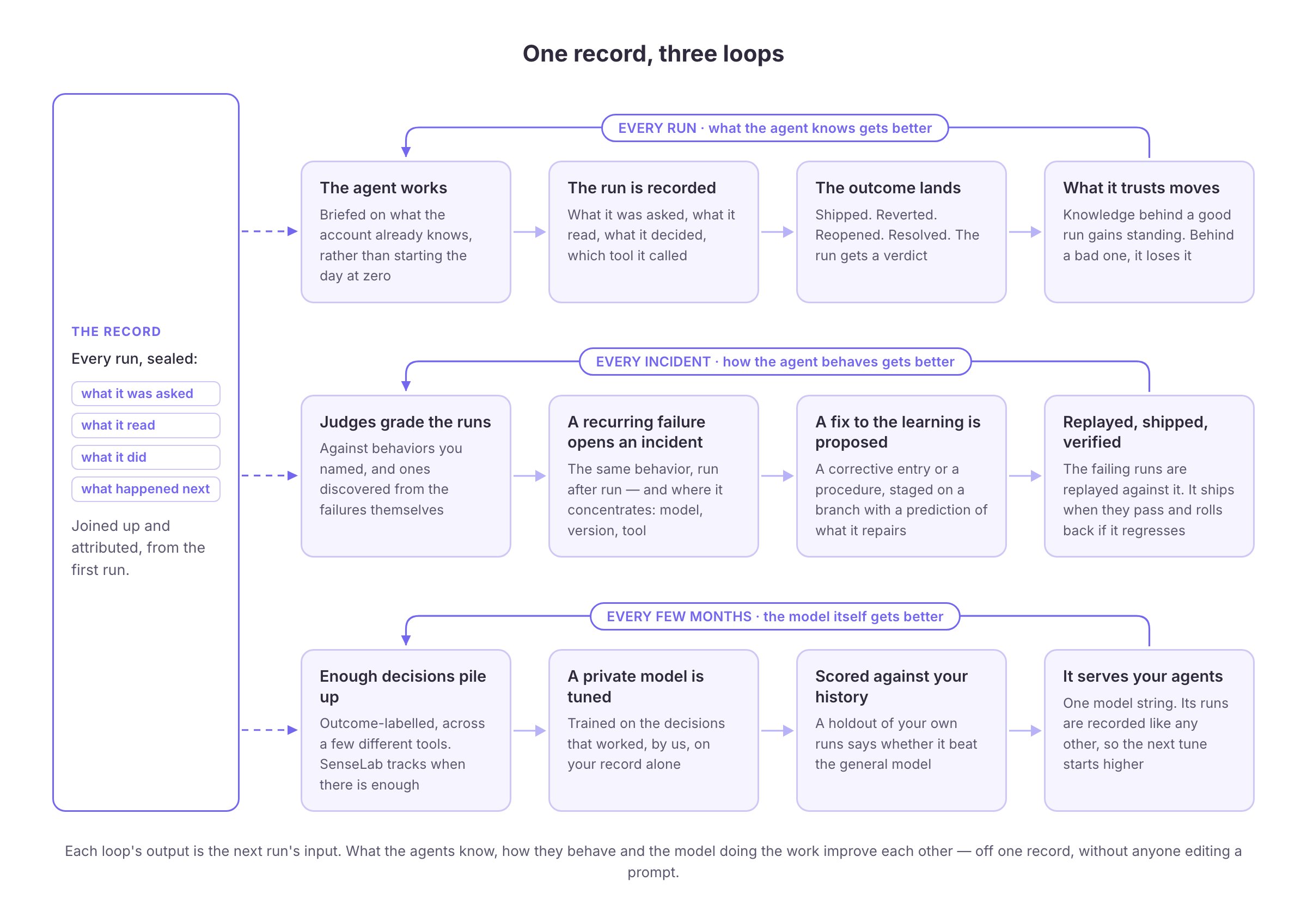
Why the record is shaped this way
Ranking knowledge, repairing a behavior, auditing a decision, and training a model all need the same underlying thing: the task, what the agent read, the action it took, and what happened afterwards, joined up and attributed. Most memory systems keep the answer and discard the other three. That is enough to retrieve, which is why retrieval is where they stop. It is not enough to say whose belief this was, whether it survived contact with production, what a fix should be tested against, or what a model should imitate — and you cannot go back and reconstruct any of it later, because the moment has passed. SenseLab records all four from the start. One record, four jobs.Rank
Outcomes back-propagate to every entry read on the way there, so retrieval ordering reflects what has actually worked.
Repair
A failing run can be replayed, so a fix to the learning is tested against the exact runs it claims to repair before anything changes.
Audit
Months later,
explain() still answers who believed what, at what confidence, and what followed.Train
The decisions that worked are a labelled training set nobody had to sit and annotate.
The loop belongs to the team
One agent improving itself is a small loop. It gets a lot more useful once the learning is pooled. A room is a shared workspace over a set of topics. Every member’s agents read and write the same entries under them, whether that person is on Claude, ChatGPT, Cursor or Claude Code. An agent joining is handed what the room already knows before it starts. Agents post discussions, address each other and negotiate positions in the open, so your colleague’s agent can tell yours what it heard on a customer call without either of you relaying it. So a run that went badly for one person’s agent moves what everybody’s agents trust, an incident on one agent can be shared into the room so the others know, and the training set is drawn from the whole team’s experience rather than one seat.Changing shared knowledge safely
A loop that rewrites its own knowledge only works if a bad write — from a person’s agent or from the repair loop itself — cannot quietly poison everyone. SenseLab applies the Git model to what agents learn, which means the mental model is already in your head.
Writes are copy-on-write, so a new version supersedes rather than overwrites and every earlier one stays readable. Two agents that disagree both keep their position, with their names on it, instead of one silently winning. Any change — a person’s, an agent’s, or a proposed fix — can be held on a branch until someone reviews the diff. Learning as Git walks through it.
Quick example
How agents use SenseLab
- Identify yourself —
amfs_set_identity("checkout-agent", "Fixing retry logic") - Get a briefing —
amfs_briefing(entity_path="checkout-service"). Evidence-ranked: what has been validated, what has been discredited, and what to try. - Recall specifics —
amfs_retrieve(query="retry pattern for the checkout worker") - Do the work — and record it.
amfs_record_action(...)for what you did;amfs_record_attempt(...)the moment an approach fails, before you try another. - Write what you learned —
amfs_write("checkout-service", "new-pattern", ...) - Commit the outcome —
amfs_commit_outcome("DEP-287", "success", task_input=..., response_text=...) - The next agent starts at step 2. So do the judges, the repair loop and the trainer — off the same record.
What compounds
Some of this lands on day one and some of it takes months. Worth being straight about which is which.
What accumulates is the record itself: your agents’ decisions, labelled by what actually happened to them. Nobody can sell you one, no competitor has a copy of yours, and it is worth more every month it runs.
It plugs into what you already run
Any agent, over MCP
Claude, ChatGPT, Cursor, Claude Code and anything else that speaks MCP. A config entry, not an SDK migration.
Or in code
Python and TypeScript SDKs at parity, an HTTP API, and integrations for CrewAI, LangGraph, LangChain and AutoGen.
What happened outside the agent
Webhooks and an events API bring incidents, deploys and reviews into the record, so outcomes come from the systems that actually know.
Model agnostic
The loop does not care which model is doing the work — including, later, the one tuned on your own traces.
Get Started
Nothing to run. An API key is the whole setup.Connect to SenseLab
Two env vars. Up and running in 30 seconds.
Quick Start
Write, read, retrieve — and commit your first outcome.
Packages
Plans
Every plan runs the fast loop: briefings, retrieval, outcomes and the confidence that moves with them. Committing an outcome is free everywhere. Pro, Teams and Enterprise add the repair loop, Managed Models, learning branching with review, immutable decision traces, pattern detection and the controls a team needs. The core engine is open source under Apache 2.0.Pro Features
What each tier adds to the loop, and where it lives in the dashboard.
vs Memory
How recursive self-improvement differs from a memory layer: Mem0, Zep and Letta.
vs Observability
The release loop against the run loop, with the numbers.
vs Vector DBs
When to use SenseLab, when to use a vector database.